
New Jersey Tech, Business, & Creative Resources

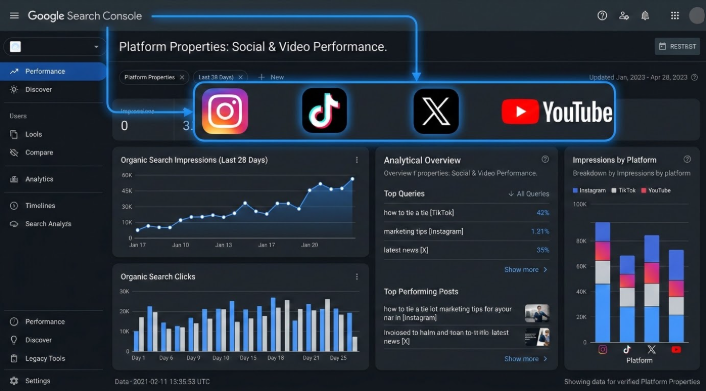
Google Bridges the Analytics Chasm, Bringing Social Media Giants Into Search Console

Google just broke down a major analytics silo — you can now track your social and video content's organic search performance right inside Search Console.
In a massive paradigm shift for digital creators and enterprise brands alike, Google has officially dismantled one of the longest-standing silos in web analytics. Site owners, digital marketers, and solo creators can now track the organic search performance of their social media and video content directly inside Google Search Console.
The search giant has quietly rolled out a entirely new asset class called Platform Properties. The feature allows users to integrate and monitor performance data from four dominant external channels: Instagram, TikTok, X (formerly Twitter), and YouTube.
For the first time in the history of Search Console, users are being granted deep, query-level visibility into domains they do not own or manage at a developer level.
From Black Box to Granular Transparency
Historically, tracking how a viral TikTok or an authoritative video on YouTube pulled traffic from Google Search was an exercise in guesswork. Traditional analytics platforms lumped this traffic into vague “referral” buckets, leaving creators blind to the exact search queries driving discovery on Google Search and Discover.
With this roll-out, spearheaded by Moshe Samet, Product Manager Lead for Search Console, Google is offering native analytics tailored specifically to social environments.
Once an account or channel is authorized and verified, Search Console generates three core analytical areas for the platform property:
- The Performance Report: This surface delivers standard Search Console metrics—total impressions, clicks, average click-through rate (CTR), and search position. Crucially, it allows marketers to filter data to isolate exactly which individual posts and search queries are driving the highest volume of traffic.
- The Insights Report: A higher-level overview focused on recent traffic trends and macro discovery patterns, outlining how audiences find a specific profile on Google.
- Achievements: A gamified milestone tracker highlighting growth and specific audience acquisition thresholds over rolling 28-day windows.
The Strategic Play: Why This Matters
This update builds upon a minor December 2025 pilot experiment called “Social Channels in Search Console Insights,” but expands it into a fully fleshed-out enterprise reporting system. Industry insiders caught a glimpse of this launch a few weeks ago when a series of help documents prematurely went live before being abruptly scrubbed from the web. Now, the documentation is fully live, and the rollout is progressing globally.
The implications for digital strategy are far-reaching, particularly for agencies managing multi-channel brand footprints and creators who rely entirely on social ecosystems without a standalone website.
Crucial Distinction: Platform Properties function entirely as private analytics tools. They do not create public search profiles or alter how content appears to users. They simply map out the invisible search funnels already funneling users from standard Google search results to third-party applications.
Furthermore, Search Console treats specific content types with precise mapping. For instance, an impression and click are logged even if an Instagram story or video content opens directly within a native Google view overlay rather than redirecting the user out to the parent social application.
Setting Up and Keeping Connections Live
Integration mirrors the traditional web property verification system. Users navigate to the standard property selector dropdown in Search Console, select “Add Property,” and choose from the supported array of platforms. For certain channels—notably X—early adopters report that some profiles are populating automatically without manual credential handshakes.
Because security protocols dictate periodic ownership checks, Google notes that access will occasionally pause if external API logins or tokens expire. However, re-authenticating seamlessly restores historical data streams without forcing users to rebuild their performance histories from scratch.
The feature is rolling out incrementally over the coming weeks. Digital teams should audit their Search Console property selectors frequently to claim their handles the moment the configuration interface updates.