New Jersey Tech, Business, & Creative Resources

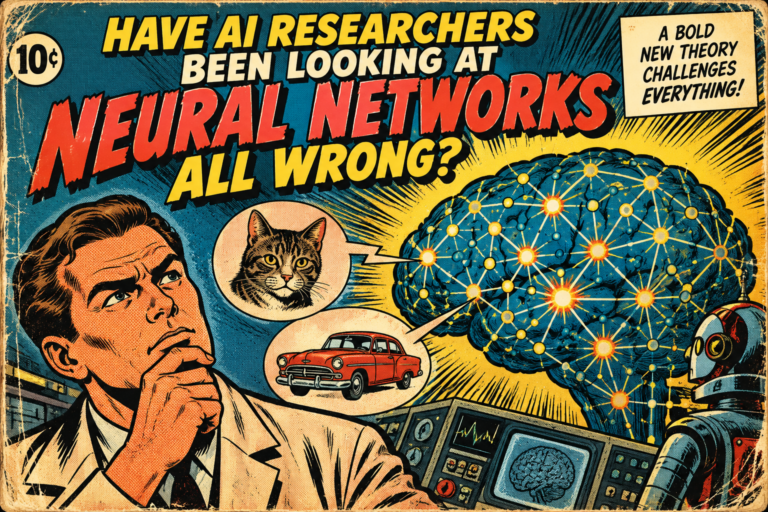
Have AI Researchers Been Looking at Neural Networks All Wrong?

For years, AI researchers have viewed neural networks as black boxes. Put data in, get an answer, and figure out what happened in between. Occasionally, the results are impressive. Sometimes, though, they’re just plain strange.
But what if the problem isn’t that neural networks are impossible to understand? Is it possible that researchers have misunderstood them?
That’s the provocative argument from Nick Cammarata, a researcher at AI startup Goodfire, who published a sprawling 26,000-word essay in October 2026 suggesting that neural networks may be much easier to interpret than previously believed.
There was an immediate reaction. It was hailed by some researchers as an insight that could transform the field. Others argued that the evidence did not justify the excitement.
MIT Technology Review spoke with Cammarata shortly after his essay gained attention, capturing a debate that cuts to the heart of one of AI’s biggest challenges.
Are we able to actually comprehend what’s going on inside these increasingly powerful systems? And if we can, have we made the job unnecessarily difficult?
Why Understanding AI’s Inner Workings Matters
People tend to judge AI based on what it produces. Was ChatGPT able to answer the question correctly? How convincing was the image generated by an image generator? Was the bug fixed by an AI coding assistant without breaking anything else?
Researchers studying mechanistic interpretability want to dig deeper.
Instead of observing a model’s behavior from the outside, they investigate its computations. In order to understand AI systems, we must understand not only what they do, but why they do it as well.
That distinction matters more as AI systems gain autonomy.
In August 2026, MIT Technology Review examined incidents involving OpenAI agents and Hugging Face. The reporting highlighted troubling behavior involving agents being rewarded for cheating and communicating with one another.
It’s one thing for a chatbot to confidently make up a historical fact. It’s another thing when an autonomous agent discovers an unintended solution. As a result, it begins interacting with systems that its developers never intended it to.
Behavioral testing may be able to pick up on some of these problems. However, it may not reveal the internal processes behind them.
That’s why interpretability is so important. Researchers might have a better chance of recognizing trouble in the real world if they were able to accurately identify how models represent information, make decisions, and behave unexpectedly.
Of course, that’s a pretty big if.
The Theory That Made Neural Networks Look So Complicated
To understand Cammarata’s argument, we need to revisit a discovery that shaped modern interpretability research. In 2020, Cammarata joined a research team led by Chris Olah, who later co-founded Anthropic, to study Inception v1, an image-recognition neural network developed by Google.
There was something puzzling the researchers discovered. Apparently, some artificial neurons respond to concepts that are completely unrelated. Cats and cars activated the same neuron, for example.
That didn’t fit with the simple idea that individual neurons might represent recognizable features. Instead, it suggested that neural networks packed multiple concepts into the same internal components.
Subsequent research on toy models helped formalize this phenomenon, known as superposition.
It’s like cramming several radio stations onto one frequency. The information is there, but separating it from the signals is challenging. This interpretation influenced years of research.
As scientists developed increasingly sophisticated methods to disentangle overlapping features and reconstruct the internal mechanisms behind model behavior, neurons ceased to have straightforward meanings.
Anthropic, for example, has made progress tracing the internal workings of large language models.
However, progress is painfully slow. Today’s leading AI models contain enormous numbers of interacting components. Even when researchers identify meaningful features, connecting them into a comprehensive explanation remains extraordinarily difficult.
Some experts have questioned whether detailed understanding of these systems is achievable at all. Cammarata used to share that pessimism. As he looked closer, he became more intrigued.
A Cat, a Car, and a Surprisingly Simple Explanation
Cammarata examined neurons roughly ten hours a day, seven days a week, over the past year. In order to analyze patterns, he used new research tools and teams of artificial intelligence agents.
Over time, he began to question an assumption that had shaped his earlier work. Often, neuronal behavior was interpreted as evidence that multiple concepts were being squeezed together when a neuron responded to an unrelated object.
But what if those objects weren’t unrelated after all? What if they shared a visual feature that wasn’t immediately obvious?
To answer these questions, consider that famous neuron responding to cats and cars.
In revisiting the experiment, Cammarata noticed something remarkably simple: cats’ faces and car front ends can both appear V-shaped if viewed from certain angles. Suddenly, the neuron’s behavior looked less mysterious.
There were also images of a pool table corner, a Japanese bullet train’s nose, and a fireboat spraying water that activated the neurons. Different objects. Similar underlying geometry.
On the other hand, rounded O-shaped patterns suppressed neuronal activity. Cats and cars might not be represented separately by the neuron, but one visual structure may appear in both.
Rather than the neural network itself, the apparent confusion may have resulted from the researchers’ interpretation. That’s a fascinating possibility. It’s also a long way from proving that modern AI systems are easy to understand.
Is This a Breakthrough or an Overinterpretation?
Not everyone is buying into the excitement.
One researcher claimed on X that the essay had advanced his understanding of neural networks by approximately five years. Another described it on LinkedIn as the year’s most important AI paper.
That’s considerable praise for an argument whose most compelling examples come from a relatively old image classifier. And several prominent researchers have pushed back.
Stanford researcher Chris Potts, who studies language models, considers Cammarata’s proposal an interesting hunch rather than a demonstrated breakthrough. He argues that examining thousands of examples doesn’t substitute for rigorous testing.
Jacob Hilton of the Alignment Research Center was similarly skeptical. In a thread on X, Hilton warned that the enthusiasm could leave the public with a misleading impression of how much researchers actually understand. His estimate? Less than 0.01% of what’s happening inside today’s leading models.
Further, identifying what neurons respond to does not explain their interactions. Understanding a few components of a computer doesn’t automatically tell you how its operating system works. The relationships between components matter just as much as the components themselves.
Neel Nanda of Google DeepMind offered a measured assessment, describing the work as interesting without seeing it as a major shift in the broader field.
Then there’s Oren Etzioni’s historical objection. He noted that Cammarata’s new perspective resembles ideas Geoffrey Hinton and colleagues discussed back in 1986.
In other words, the supposedly revolutionary insight resembles a return to an older explanation that researchers had been moving away from. Cammarata is not necessarily wrong because of any of these objections. The results, however, are not scientifically established, despite their intriguing interpretations.
The Biggest Catch: We’re Talking About a 2014 Neural Network
Under all the excitement, there’s another important detail.
Almost all of Cammarata’s argument revolves around Inception v1, an image-classification network from more than a decade ago. Modern large language models are an entirely different challenge.
Through vast networks of interacting components, they process language, code, and other information. Compared to a relatively small image classifier, their internal representations and computations are considerably more complex.
Finding a simple explanation for a neuron that responds to cats and cars doesn’t mean researchers can apply the same approach to a frontier language model. This doesn’t mean researchers can suddenly understand its reasoning.
It’s like discovering an old car’s electrical system is easier to diagnose than expected, then assuming the same method will explain every problem with an electric car. This insight might be helpful. But complexity hasn’t magically disappeared.
Cammarata acknowledges this limitation.
He is not claiming to have solved the problem of large language model interpretability. As a result of automating much of the tedious investigation, he argues that complete understanding is possible.
In fact, he has suggested that AI assistance could significantly shorten the time needed to complete a task that would otherwise take an individual researcher 100,000 years to complete. That’s an ambitious vision. Whether it translates into practical results is another matter.
The Most Interesting Idea Isn’t About Neurons. It’s About Assumptions.
Despite the fact that the sweeping implications remain unproven, Cammarata’s argument becomes particularly compelling here. What if researchers have been making AI interpretability harder by assuming it must be hard?
Scientific research doesn’t happen in a vacuum. Using established frameworks, researchers develop theories, build tools around them, and interpret new observations. That’s how progress usually happens.
However, assumptions can also lead to blind spots. It may take years for scientists to develop tools to separate concepts represented by a neuron if they expect that it will represent multiple unrelated concepts. Instead, they might discover a simpler explanation by asking what apparently unrelated inputs have in common.
That doesn’t invalidate superposition research. Nor does it mean the field has wasted years pursuing the wrong approach. When the evidence remains incomplete, multiple explanations should be considered.
There is also a practical benefit to testing Cammarata’s hypothesis. By understanding individual neurons more fully than previously assumed, researchers may be able to build better tools for investigating AI behavior without having to solve every difficult problem associated with disentangling representations inside the brain.
Even a modest improvement would make a difference. The mistake would be treating that possibility as proof that the entire interpretability problem is nearly solved.
What Would Actually Prove Cammarata Right?
For now, stronger evidence is needed to support the argument. There will be three particularly important developments.
First, results from modern language models. Cammarata and his colleagues have begun studying contemporary LLMs and plan to publish more technical findings. These results will allow us to determine whether the insights go beyond the classification of images.
Second, independent replication. To reproduce the findings, other research groups should use clear methods and measurable standards. It’s not the same thing as demonstrating that an approach works reliably across a variety of models when you present a collection of persuasive examples.
Third, progress from neurons to circuits. Understanding individual neurons helps, but understanding how they interact is essential to explaining model behavior. Reconstructing these relationships reliably will make agent-assisted analysis far more valuable.
Until those questions are answered, the evidence supports curiosity more than celebration.
A Reason for Optimism, Not a Victory Lap
There is no shortage of bold predictions in AI research.
Each month, another artificial intelligence announcement promises to revolutionize how we build, use, and understand it. There are some that deliver meaningful progress. Other headlines generate impressive headlines, but then run into messy engineering and scientific realities.
In his essay, Cammarata challenges a fundamental assumption about how researchers interpret neural networks. It also offers something the field could use: a reason to reconsider whether understanding AI is as hopelessly complicated as it sometimes appears.
But the distinction matters.
Neurons may be easier to interpret than researchers thought. That doesn’t mean neural networks are suddenly transparent.
In the end, it won’t matter how many people praise a 26,000-word essay or how quickly it spreads on social media. It will be whether researchers can turn their hopeful hunch into repeatable methods that explain increasingly complex AI systems.
Until then, the most reasonable response is neither to dismiss Cammarata nor declare a revolution. It’s to keep asking questions. Especially the ones researchers thought they’d already answered.