New Jersey Tech, Business, & Creative Resources

Why Macron and Modi are Bypassing Ministers to Text Tech Billionaires

World leaders are now texting tech billionaires directly instead of going through ministers — a two-decade tech reporter breaks down why AI has rewritten the rules of global diplomacy.
In over two decades of covering the tech sector, I’ve watched the frontline of global competition shift repeatedly. We went from the software wars of the early 2000s to the smartphone gold rush, and later, the race for cloud dominance. But what we are witnessing right now is entirely unprecedented. The battle for artificial intelligence has officially broken out of the research labs and boardrooms, morphing into a raw, geopolitical land grab for raw infrastructure: power, land, and silicon.
The most fascinating part of this shift isn’t the technology itself—it’s how it is being negotiated. Policy papers and bureaucratic trade missions are out. Direct, leader-to-CEO diplomacy is in.
French President Emmanuel Macron and Indian Prime Minister Narendra Modi have emerged as the most aggressive practitioners of this new playbook. Both leaders understand a fundamental truth that many Western governments are lagging on: the people who control the massive pools of capital required for AI infrastructure respond to direct engagement from heads of state, not stacks of regulatory paperwork.
Macron’s Nuclear Pitch and the €75B Text Exchange
Let’s look at France first. Emmanuel Macron has spent the last year transforming Paris into the undisputed AI capital of Europe, and his latest victory is a masterclass in personal courting.
In May, SoftBank committed an eye-popping €75 billion to build out 5 gigawatts of AI data center capacity in France. The first phase alone involves dropping €45 billion into the Hauts-de-France region to deliver 3.1 gigawatts by 2031.
How did this happen? It didn’t start with a formal trade proposal. It started because Macron personally requested a private meeting with SoftBank founder Masayoshi Son months prior, subsequently closing the gaps via direct text messages.
Macron understood exactly what a hyperscale data center operator needs most right now: juice. AI clusters consume an immense amount of electricity, and France’s stable, state-backed nuclear energy grid is the ultimate bait. Macron didn’t just offer access; he actively leaned on state-owned utility EDF to free up sites—including a former power plant in Bouchain—and bumped the government’s power guarantee from 2 gigawatts to 3 gigawatts to seal the deal.
Macron followed this up during France’s G7 presidency in June, bypassing standard diplomatic protocol to host a working lunch that sat world leaders directly next to the elite of the AI world: OpenAI’s Sam Altman, Anthropic’s Dario Amodei, Google DeepMind’s Demis Hassabis, and Mistral’s Arthur Mensch. It is a highly effective charm offensive that has turned France into a premier destination for frontier compute.
Modi’s Blueprint: Shifting from Service Providers to Sovereign Infrastructure
Meanwhile, in New Delhi, Prime Minister Narendra Modi is running a parallel playbook with a different, yet equally massive, scale. For decades, India was viewed by Silicon Valley primarily as a backend engine—the world’s largest pool of engineering talent and IT service providers. Modi is aggressively rewiring that perception into a “Design and Develop in India” paradigm.
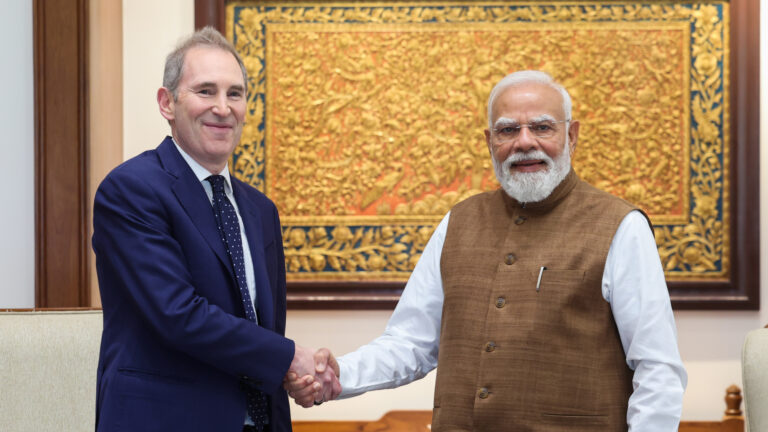
Following a direct meeting with Modi in late June, Amazon CEO Andy Jassy announced a staggering $48 billion investment commitment in the country through 2030. Crucially, $21 billion of that capital is explicitly earmarked to scale AI and cloud infrastructure across hubs in Mumbai and Hyderabad.
Modi’s strategy isn’t just about hosting American cloud giants, though. It’s an explicit push for sovereign AI capability. Over the past year, Modi has held personal, bilateral meetings with a massive roster of tech leaders, including Microsoft’s Satya Nadella, Google’s Sundar Pichai, and top AI startup founders.
The momentum is tangible:
- Google has committed $15 billion toward creating its largest AI hub outside the United States.
- Microsoft has launched its largest Asian infrastructure investment to date to anchor local cloud capability.
- The Semiconductor Bridge: Knowing that data centers are useless without chips, Modi is pushing hard on domestic fabrication. Tata Electronics is moving forward with a 300mm semiconductor fab plant, backed by advanced lithography equipment secured via diplomatic channels from Dutch giant ASML, with tech luminary Lip-Bu Tan acting as a prospective anchor customer for the chips.
The Reality Check: Pledges vs. Power Grids
As someone who has seen countless tech “commitments” evaporate into thin air over the two decades, we have to look at these massive figures with a healthy dose of journalistic skepticism.
There is a distinct “pledge bubble” in the AI world right now. SoftBank’s €75 billion is an “up to” figure; Amazon’s billions are spread across years. We only have to look across the English Channel to see a cautionary tale. In April, OpenAI quietly paused its massive “Stargate UK” data center project, frozen out by British electricity prices that are nearly four times higher than the US, alongside swirling regulatory headaches. Tech investments can vanish the moment the local grid or local regulators blink.
The differentiator right now is that France and India are backing their charm offensives with immediate concrete action. France already has construction underway at verified EDF sites. India has implemented long-term fiscal tax incentives tailored specifically for hyperscale operators to ensure that corporate reputations remain tied to strict delivery timelines.
The Macro View
What Macron and Modi have realized is that AI infrastructure is no longer just a corporate line item; it is strategic industrial capacity, negotiated like oil reserves or steel mills in the 20th century.
The countries that rely purely on overseas AI models and computing hardware leave themselves entirely exposed to the whims of foreign export controls and geopolitical shifts. By taking the lead personally, texting the billionaires, and clearing the bureaucratic red tape, both leaders are ensuring their nations aren’t just consumers of the AI future—they are the ones housing its engine rooms.