New Jersey Tech, Business, & Creative Resources

The Silent Re-Architecting of the World Wide Web

Google quietly dropped two new technical specs built exclusively for machines, not humans — here's what the Open Knowledge Format means for how the web actually works.
The World Wide Web is undergoing a quiet, fundamental mutation. Underneath the familiar surface of visual layouts, cookie consent banners, and human-readable text, tech platforms are laying down a parallel infrastructure designed exclusively for machines.
Over the span of just a few weeks, Google quietly dropped two new technical specifications: the Open Knowledge Format (OKF) and the Agentic Resource Discovery (ARD) protocol. Combined with the rapid adoption of Anthropic’s Model Context Protocol (MCP) and the grassroots spread of llms.txt files, it is clear that the web is growing a second layer—or perhaps a third head.
For digital marketers and search engine optimization (SEO) professionals, the knee-jerk reaction has been typical: declare Markdown the absolute future of the web or dismiss the changes entirely as overhyped AI noise. The reality is far more complex. The web is fracturing into distinct layers of machine communication, and navigating this new landscape requires understanding exactly what each layer is built to do.
The Six-Layer Cake of AI Readiness
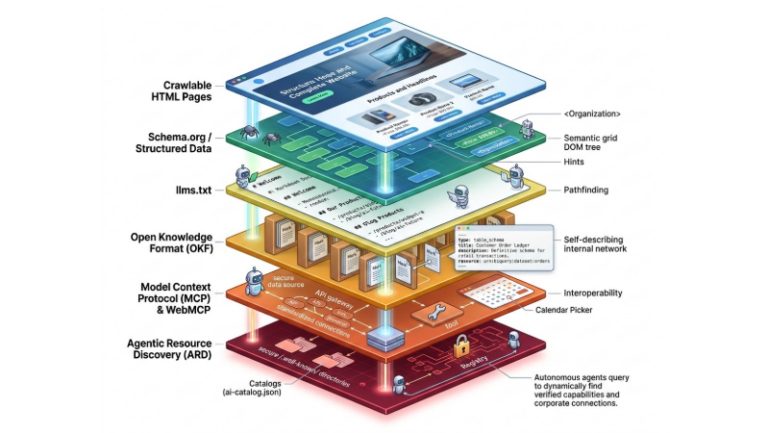
To understand how autonomous AI agents see your website, you have to look at the emerging web architecture as a stack of six distinct, complementary layers rather than competing formats:
- Crawlable HTML Pages: The legacy foundation. It remains the bedrock of how search engine bots and web crawlers map out the internet.
- Schema.org / Structured Data: Semantic vocabulary baked directly into HTML. Think of it as explicit hints that tell a machine, “This text isn’t just a string of numbers; it’s a product price.”
- LLMs.txt: Positioned at the root directory of a domain, this plain Markdown file acts as an internal tour guide. It tells an AI agent that has already arrived on your site which pages contain the highest-signal information.
- Model Context Protocol (MCP) & WebMCP: An open standard created to solve the “interoperability problem.” MCP standardizes how an AI connects to data sources and secure tools. Its sibling, WebMCP, gives websites a direct way to let AI agents interact with live page elements—like filling out forms or picking calendar dates—rather than relying on unpredictable web scraping.
- Open Knowledge Format (OKF): A lightweight system for bundling Markdown files together using standardized metadata to create self-describing internal libraries.
- Agentic Resource Discovery (ARD): An infrastructure standard that enables autonomous agents to find, evaluate, and securely connect to capabilities, tools, and other agents across different corporate boundaries at runtime.
Deconstructing OKF: A Library, Not a Shortcut
When Google Cloud’s data team introduced the Open Knowledge Format, the AI community immediately began projecting marketing use cases onto it. In practice, however, OKF is disarmingly simple: it is a directory of Markdown files where each document features a small YAML frontmatter block declaring a type, title, and optional tags.
YAML
—
type: table_schema
title: Customer Order Ledger
description: Definitive schema for retail transactions.
resource: urn:biquery:dataset:orders
—
While some SEO commentators have rushed to position OKF as the ultimate “AI search hack,” its origins tell a different story. OKF wasn’t built to optimize marketing blogs; it was engineered for enterprise data operations. It allows internal AI agents to seamlessly share table schemas, operations runbooks, and metric definitions without getting trapped in proprietary software silos.
Furthermore, flattening a dynamic website into a web of basic Markdown documents does not yield a true knowledge graph. A true knowledge graph relies on typed, mathematically query-able relationships. OKF leaves the meaning of a link entirely up to the author, meaning an LLM must still use semantic reasoning to infer what a relationship means every single time it encounters a link. Self-reported metadata files are inherently vulnerable to manipulation, and major search engines will continue relying on multi-step retrieval-augmented generation (RAG) pipelines and independent validation rather than taking a raw Markdown file at face value.
The Markdown Mirage: Why Killing HTML is a Mistake
The sudden rush to create shadow, text-only versions of websites specifically for AI bots has drawn sharp criticism from veteran web architects. Google’s Search Relations lead, John Mueller, flatly addressed the discovery issue on the Search Off the Record podcast, noting that self-reported files like llms.txt cannot help an LLM decide which website to rank over another for a given query.
“In an LLM system, it basically, by design, can’t trust what is here as a way of differentiating between different websites.” — John Mueller, Google Search Relations
When you strip away HTML to serve raw Markdown to a machine, you lose vital structural context. Modern web layouts—navigation hierarchies, sidebars, footers, and visual placement—are editorial artifacts that signal importance and human intent. Flattening a page into raw text removes that human judgment.
The primary exception where Markdown alternatives make sense is developer documentation or API references, where an AI agent already looking at your site simply needs low-noise text to extract technical parameters or code snippets efficiently. For mainstream commercial or editorial websites, standard, semantically clean HTML remains the definitive source of truth.
ARD and the Shift to Autonomous Web Connections
While OKF focuses on how knowledge is packaged, Google’s concurrent announcement of the Agentic Resource Discovery (ARD) specification addresses an entirely different bottleneck: how AI agents find capabilities.
Historically, an AI agent had to be manually hard-coded to an API or tool before it could use it. This model falls apart at web scale. Developed alongside tech giants like Microsoft, Nvidia, Salesforce, and the Linux Foundation, ARD introduces two new primitives to the web:
- Catalogs (ai-catalog.json): A static file hosted under a site’s secure /.well-known/ directory. It securely advertises what an organization’s systems can do (e.g., its available MCP servers, tools, or public APIs), using domain ownership as a cryptographic anchor of trust.
- Registries: Federated search engines built for machines. These registries crawl web catalogs, index capabilities, and allow an autonomous agent to query a single endpoint to discover tools dynamically at runtime.
If llms.txt is a store directory for an agent that has already walked through your front door, ARD is a business listing detailing the precise services your company can execute for external partners.
The Path Forward for Digital Architects
The web is undeniably splitting into two concurrent interfaces: one optimized for human eyes and browsers, and another streamlined for agentic automation. For the vast majority of web properties, the fundamental rules of the road have not rewritten themselves overnight. Clear site architecture, high-authority content, and robust semantic HTML are still your best defense and offense.
Investing thousands of dollars into maintaining shadow Markdown versions of a standard marketing site is an expensive distraction from fixing foundational issues like poor user experience or an undefined brand identity. However, if your enterprise manages extensive programmatic interfaces, live data repositories, or complex consumer tools, tracking protocols like MCP and ARD is no longer optional. They represent the digital plumbing of a web built for autonomous action—a network where discovery is defined not just by what your brand says, but by what your systems can verify and execute.