New Jersey Tech, Business, & Creative Resources

How MIT Spinoff Derq is Powering NJ’s World Cup Traffic Infrastructure

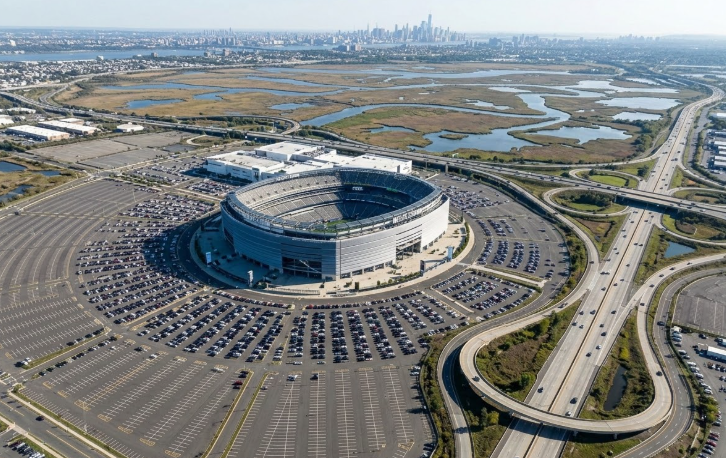
With over a million soccer fans poised to descend upon the New York-New Jersey region for the 2026 FIFA World Cup, local transit authorities are facing an unprecedented logistics hurdle. Gridlock around MetLife Stadium is a given – unless the technology managing it is fundamentally upgraded.
Enter Derq, an artificial intelligence-driven intelligent transportation company that has quietly become a critical linchpin in regional mega-event logistics. The New Jersey Department of Transportation (NJDOT) has tapped the company to deploy its real-time safety and traffic analytics platform across 95 critical sites surrounding the stadium and throughout the Meadowlands area.
From MIT Labs to the World Stage
To understand the scale of the MetLife Stadium deployment, one must look at Derq’s engineering pedigree. Founded in 2016 as a spinoff from the Massachusetts Institute of Technology (MIT), the Detroit-based company has steadily amassed a portfolio of 20 patents centered around computer vision, sensor fusion, and machine learning.
Unlike legacy Intelligent Transportation Systems (ITS) that rely on fragmented, historical data or inductive loop counters buried in asphalt, Derq’s technology is natively hardware-agnostic. It acts as an intelligent software layer capable of ingesting data from existing infrastructure, such as state-owned CCTV cameras and radar – and processing it in real time.
For NJDOT, this means converting passive video feeds into a living, breathing data stream. Derq’s platform is being woven directly into New Jersey’s Advanced Traffic Management System (ATMS) to automate the detection of a massive array of roadway anomalies:
- Instant Incident Detection: Automated flagging of crashes, wrong-way driving, and vehicle breakdowns.
- Multimodal Monitoring: Real-time tracking and counting of pedestrian spikes and right-of-way intrusions – vital for managing stadium exit crowds.
- Environmental Hazards: AI-enabled detection of localized fires or animal intrusions.
“Major events like the World Cup require transportation agencies to anticipate risks, adapt to changing conditions and operate more proactively,” noted Dr. Georges Aoude, co-founder and CEO of Derq. “By delivering continuous insights and real-time alerts, we enable transportation agencies to operate more proactively.”
Scaling the Intelligently Connected Intersection
The New Jersey deployment comes on the heels of another massive win for the company. Just days prior, the City of Montréal announced a citywide rollout of Derq INSIGHT across 100 intersections, marking one of the largest single AI-traffic deployments in North American history.
What makes Derq’s technology particularly appealing to enterprise municipalities and state bodies is its dual-architecture offering:
- Derq INSIGHT: A platform focused on safety analytics, diagnostic deep dives, and Automated Traffic Signal Performance Measures (ATSPMs) to establish long-term optimization trends.
- Derq SENSE: An edge-computing application designed for real-time V2X (Vehicle-to-Everything) communication, predicting road user trajectories to actively prevent collisions before they happen.
By integrating seamlessly with regional engineering partners – such as HNTB (which led the NJDOT implementation design) and SCP Signal Control Products – Derq avoids the costly hardware overhauls that traditionally stall public sector tech adoption.
A Legacy Beyond the Tournament
The immediate objective of this deployment is surviving the World Cup crunch, but the architectural implications for New Jersey are permanent. Once the final whistle blows and the crowds disperse, the intelligent infrastructure laid down by Derq will remain active.
For a region infamous for its complex highway intersections and unpredictable weather, a persistent, AI-managed traffic network promises a massive baseline improvement for everyday commuters. For Derq, the high-visibility project is an ideal sandbox to prove its enterprise scalability on the world’s biggest stage.